Personal injury litigation is, at its core, a document-intensive practice. A single motor vehicle accident case can generate hundreds of pages of emergency room records, specialist notes, physical therapy logs, imaging reports, pharmacy printouts, and billing statements — and that's before you add police reports, witness statements, and insurance correspondence. For a small firm handling a full docket, the sheer volume of paper can become a strategic liability: critical details get missed, timelines blur, and the demand letter that should tell a compelling story ends up reading like a disorganized summary.
That's exactly where an AI case companion for personal injury changes the equation. Rather than replacing attorney judgment, it handles the mechanical, time-consuming work of reading, organizing, and cross-referencing thousands of pages — so your team can focus on strategy, client relationships, and the advocacy that actually moves cases forward.
The Medical Records Problem Every Personal Injury Firm Knows
Ask any paralegal at a busy personal injury firm what their biggest time drain is, and the answer is almost always the same: medical records. Gathering them takes weeks. Organizing them takes more. And actually reading them closely enough to extract every treatment date, every diagnosis, every gap in care, and every dollar of special damages? That can take an experienced paralegal significant time per case.
The problem compounds as a firm grows. A two- or three-attorney shop handling 80 to 150 active matters simultaneously faces a genuine capacity ceiling. You can hire more staff, but that increases overhead and doesn't necessarily improve accuracy — human reviewers get fatigued, and a missed notation buried on page 247 of a hospital record can undermine an otherwise strong demand.
Effective medical record management for personal injury lawyers requires more than just reading records. It requires:
- Chronological organization — mapping every treatment event in sequence so gaps and causation arguments are immediately visible
- Diagnosis tracking — linking each diagnosis to the treating provider, the date, and the underlying mechanism of injury
- Special damages extraction — capturing every billable charge, co-pay, and out-of-pocket expense with the source document and page number
- Possible-conflict flagging — flagging when a provider's notes conflict with another provider's findings, or when a client's reported symptom history doesn't match the documented record
Doing all of this manually is not just slow — it's an error-prone process that scales poorly. AI tools for personal injury case preparation address this directly.
How AI Tools for Personal Injury Case Preparation Actually Work
The term "AI" gets applied loosely in legal tech marketing, so it's worth being specific about what a genuine AI case companion for personal injury actually does in practice.
ProvaLens, for example, reads your entire case file — PDFs, Word documents, scanned images (via OCR), audio depositions, video recordings — and returns answers cited to the exact page and paragraph. Upload a 400-page hospital record and ask "What did the treating physician say about the mechanism of injury at the initial evaluation?" and you get a precise answer with a source citation, not a vague summary.
Beyond question-and-answer, the platform automatically:
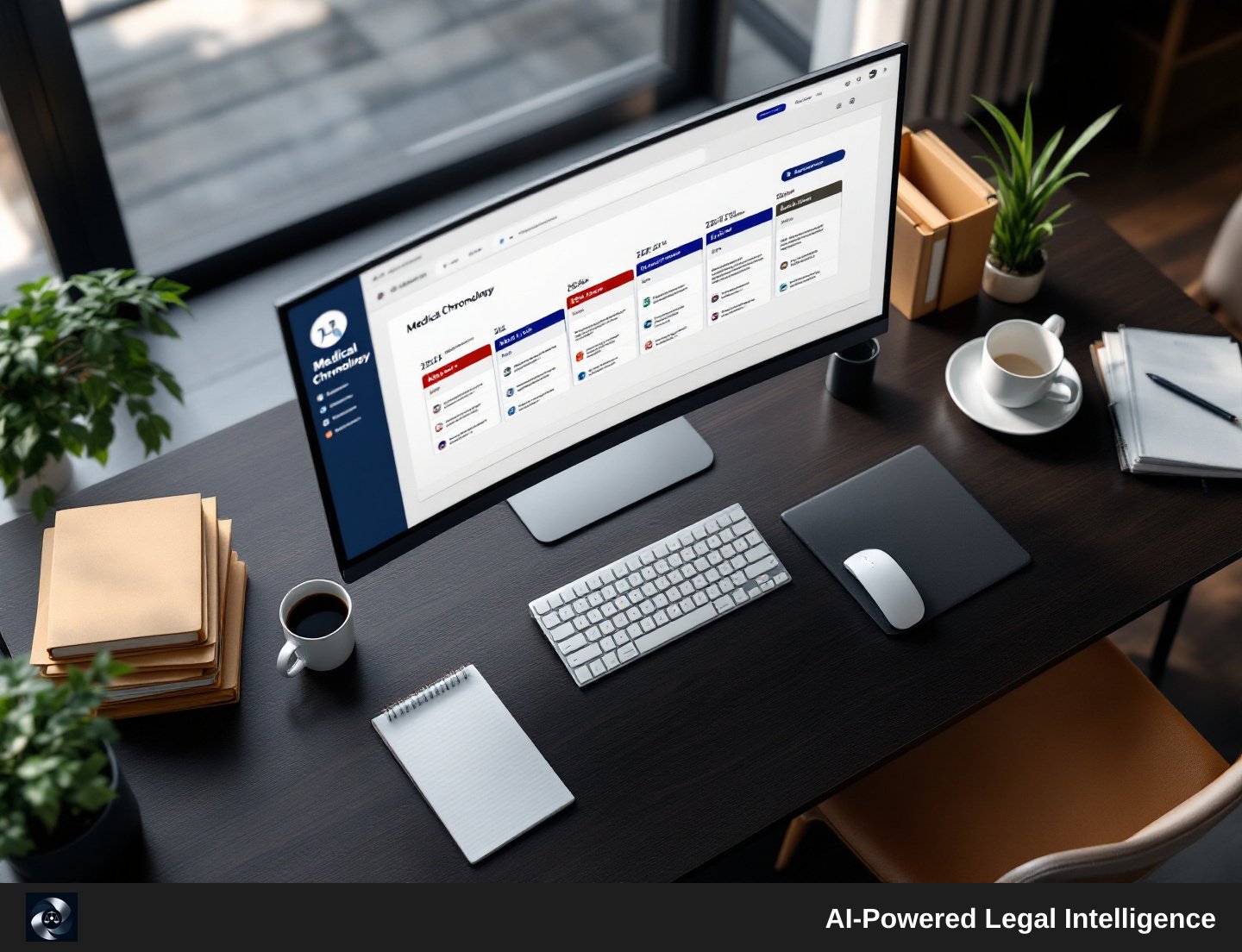
- Builds a filterable chronological timeline from all documents in the matter, so you can see the entire sequence of events — accident, first treatment, follow-up care, gaps, maximum medical improvement — at a glance
- Generates itemized special-damages tallies, pulling every charge from every medical bill and organizing them by provider and date
- Creates medical chronologies that can be exported and used directly in demand preparation
- Flags possible conflicts and inconsistencies across documents automatically, surfacing conflicts you might not catch until opposing counsel raises them
- Classifies and organizes documents by type — medical records, police reports, insurance correspondence — so nothing gets buried in an undifferentiated file
For a firm managing dozens of active personal injury matters, this isn't a marginal efficiency gain. It's a structural change in how cases are prepared.
From Disorganized Records to a Demand Letter That Tells the Story
Settlement demands succeed or fail on narrative clarity. An adjuster or defense attorney reading your demand needs to understand, quickly and compellingly, what happened, how it affected your client, and why the damages number is justified. A demand that buries the key facts in a wall of chronological summary — or that omits a significant treatment episode because it was on page 312 of a record no one read closely — can weaken an otherwise strong case.
AI tools for personal injury case preparation create the foundation for a more complete demand by supporting thorough organization and review before the writing begins.
To illustrate how this might work in practice, consider a hypothetical small firm handling a slip-and-fall matter with records from four different providers spanning 18 months. (This is an illustrative scenario, not a real case.) Using traditional methods, organizing those records before drafting the medical chronology could consume a substantial portion of a paralegal's week. With an AI case companion, the chronology is generated automatically, the special damages are tallied by provider, and the AI has already flagged a contradiction between the orthopedist's discharge notes and a follow-up physical therapy record that suggests continued functional limitation. The attorney can walk into demand drafting with a complete, organized picture of the case — and that contradiction becomes a strategic asset rather than a liability.
ProvaLens also supports the drafting phase directly, generating liability narratives and attorney-finalized demand drafts that the attorney reviews, edits, and signs off on. The output is always subject to attorney review — the platform produces drafts, not final work product — but the drafting process starts from a foundation of complete, cited information rather than a paralegal's handwritten notes.
Managing High-Volume Dockets Without Adding Headcount
One of the most significant pressures on small personal injury firms is the tension between volume and quality. Taking on more cases generates more revenue, but it also stretches staff thinner — and in a contingency-fee practice, a poorly prepared case that settles for less than its value is a direct hit to the firm's bottom line.
An AI case companion for personal injury helps address that tension by reducing the time required to reach case-ready status on each matter. When medical record management for personal injury lawyers is handled by AI — reading, organizing, extracting, and cross-referencing — paralegals and associates can redirect their time toward client communication, deposition preparation, and the strategic analysis that actually requires human judgment.
ProvaLens's flat-rate per-firm pricing (no per-seat fees) makes this economics work for small firms specifically. A two-attorney shop pays the same monthly rate whether one paralegal uses the platform or three. And because archived cases remain searchable forever at no extra cost, the platform also functions as an institutional knowledge base — useful when a prior case's medical chronology becomes relevant to a new matter involving the same insurer or defense firm.
For firms that want even deeper analysis without building the capability in-house, ProvaLens also offers Expert Services: done-for-you AI case analysis — including interactive timelines, medical chronologies, and strategic observations prepared by the ProvaLens team. Pricing for Expert Services is not published here; contact ProvaLens directly for current rates. This is a genuine out-of-pocket case cost that a firm may bill to the client as a case expense, at cost, with appropriate client disclosure and informed consent. It is not a markup, and it is not a subscription pass-through. Note that rules governing the billing of litigation support costs vary by jurisdiction; attorneys should consult their applicable professional responsibility rules before passing this cost through to clients.
Integrating AI Into Your Existing Workflow Without Disruption
One of the legitimate concerns small firm attorneys have about adopting new technology is workflow disruption. Learning a new platform takes time, and time is the one resource personal injury firms never have enough of.
ProvaLens is designed to integrate with the tools small firms already use rather than replacing them. The platform syncs with Clio and MyCase to import matters and documents and export reports. It connects with OneDrive, SharePoint, Google Drive, and Dropbox with auto-import — meaning documents added to a shared folder are automatically pulled into the relevant matter and re-analyzed. Outlook emails and attachments can be imported directly into matters as searchable documents.
The practical effect is that a firm doesn't need to change how it stores documents or manages client communication. ProvaLens sits alongside those workflows and adds a layer of AI-powered analysis without requiring staff to learn an entirely new system from scratch.
For personal injury firms ready to stop drowning in medical records and start building demands from a position of complete information, visit provalens.ai to learn more about how the platform fits your practice.