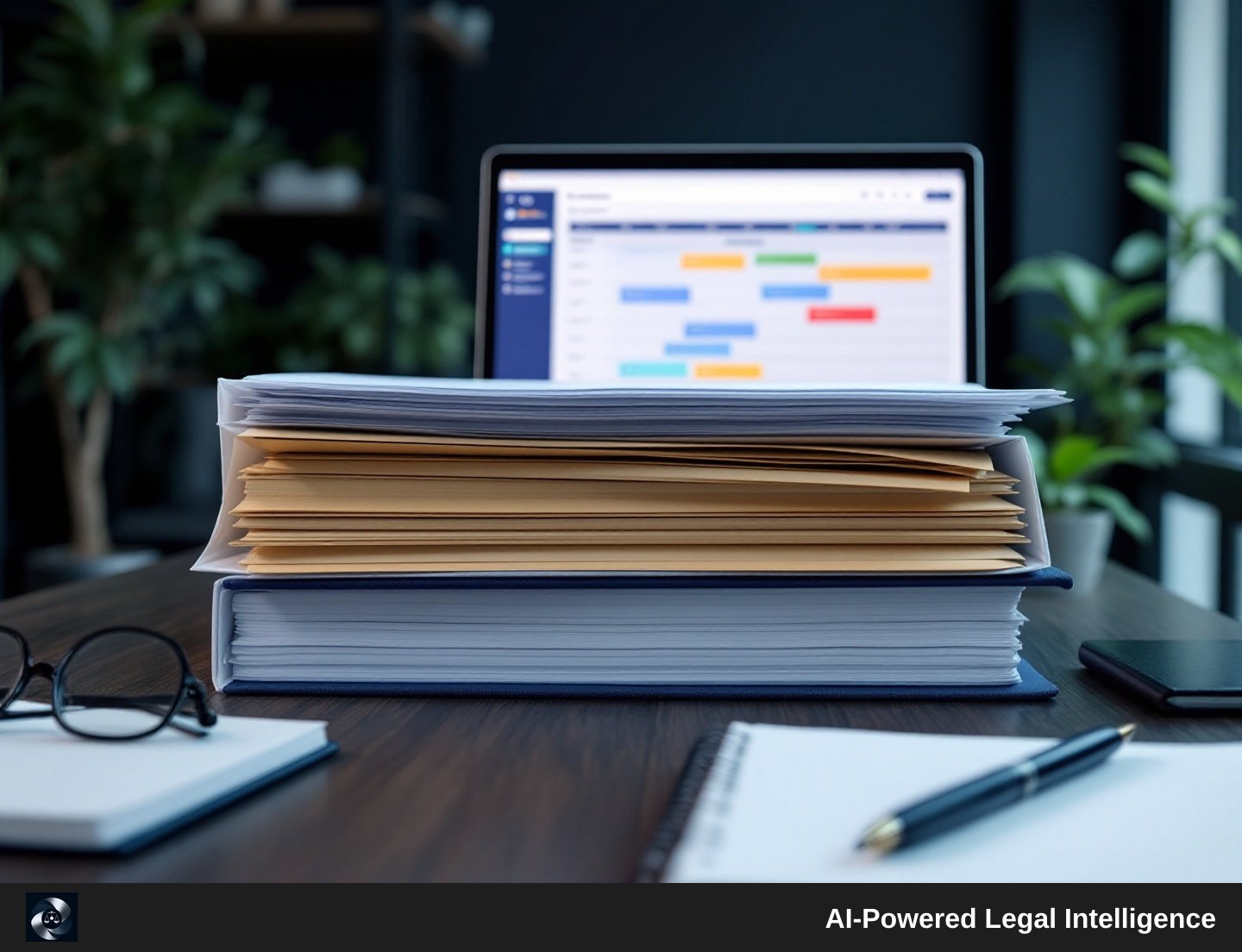
Nursing home neglect litigation is among the most document-intensive work a personal injury attorney can take on. A single case can generate thousands of pages: nursing notes written in shorthand, physician orders buried in multi-tabbed charts, medication administration records (MARs) spanning months, incident reports that were quietly amended, and therapy logs that contradict the discharge summary. The chronology of care — who did what, when, and whether it met the applicable standard — is almost always the central battlefield.
For small firms handling these cases, the challenge is not finding the evidence. It is finding it in time, in order, and in context, without assigning a paralegal to six weeks of manual review. Automated medical record review for PI law is changing that equation in meaningful ways, and the attorneys who adopt it early gain access to document-intelligence capabilities that were previously available only to firms with dedicated litigation support teams.
This post walks through why chronology is the linchpin of nursing home neglect cases, what makes medical record review so difficult at scale, and how AI-powered document intelligence platforms are helping small firms handle complex, document-heavy matters more efficiently.
Why the Care Chronology Is the Case
In a nursing home neglect matter, liability almost never hinges on a single dramatic event. It accumulates. A pressure ulcer does not appear overnight — it develops over days or weeks of missed repositioning, inadequate skin assessments, and ignored nursing notes. A fall that causes a hip fracture may be the culmination of a pattern: call-light response times that stretched longer and longer, a care plan that was never updated after a prior fall, and a staffing log that shows the unit was running short on the nights in question.
Defense counsel knows this, and their strategy often depends on the plaintiff's team being unable to piece together that pattern. They rely on the sheer volume of records to obscure what happened. A care record that runs to four thousand pages across multiple binders is not inherently confusing — but it becomes very difficult to navigate when your team is reading it linearly, in PDF format, without a tool that can surface the relevant entries across time.
The chronology is the antidote. When a jury or mediator can see, on a single interactive timeline, that the resident's weight dropped six pounds over three weeks, that the dietitian's recommendation was never implemented, and that the nursing notes for those same weeks are conspicuously brief compared to the surrounding months, the neglect becomes visible in a way that no deposition alone can achieve.
Building that chronology manually is possible. It is also extraordinarily expensive, error-prone, and slow. That is where automated medical record review for PI law enters the picture.
The Real Cost of Manual Chronology Work
Let's be precise about what manual chronology work actually involves in a nursing home neglect case. A paralegal or case manager typically reads through the entire medical record, flags relevant entries, and enters them into a spreadsheet or timeline tool — one entry at a time. In a complex case with records from multiple facilities, a home health agency, and a hospital admission, that process can take forty to eighty hours before the attorney has seen a single entry.
That labor cost is real, but it is not the only cost. Manual review introduces the very real risk of missing something. A nursing note written in abbreviations on page 1,847 of a 2,200-page chart is easy to skip. A medication order that was discontinued and then quietly restarted three weeks later is easy to miss if you are reading the chart in sections rather than tracking that medication across the entire record. These are not hypothetical oversights — they are the kinds of gaps that defense experts exploit at trial.
There is also the opportunity cost. Every hour a paralegal spends manually building a chronology is an hour not spent on client communication, discovery responses, or the next case in the intake queue. For a firm of two to eight attorneys, that tradeoff is constant and painful.
Automated medical record review for PI law does not eliminate the need for attorney judgment. It eliminates the mechanical labor — the reading, flagging, and sorting — so that attorney judgment can be applied to what matters.
How AI Transforms the Medical Record Review Process
AI-powered document intelligence platforms approach nursing home records the way a very fast, very thorough analyst would — except they do it in minutes rather than weeks, and they do not get tired on page 1,200.
Automatic Document Classification and Organization
The first problem in any nursing home case is that records arrive in no particular order. A facility's chart dump might interleave nursing notes, physician orders, lab results, and incident reports across hundreds of pages. Before you can build a chronology, you have to know what you have.
AI platforms classify uploaded documents by type automatically — separating medical records from billing records, nursing notes from therapy logs, and incident reports from care plans. This alone saves hours of sorting work and ensures that nothing gets mislabeled or overlooked.
Chronological Timeline Generation
Once documents are classified, the platform builds a filterable, chronological timeline from all of them. In a nursing home neglect case, this means you can pull up every nursing note from a specific two-week window, overlay it with the medication administration record for the same period, and immediately see whether the care documented matches the care that should have been provided under the resident's care plan.
This kind of cross-document, time-anchored analysis is what makes patterns visible. To illustrate with a purely hypothetical scenario (not a ProvaLens output): imagine reviewing a case where a fall occurred on the seventh consecutive night when the staffing log, the incident report, and the nursing notes all reflect a pattern of delayed call-light response. A filterable timeline that surfaces all three document types together — each cited to its source page and paragraph — is the kind of tool that makes that pattern legible. That is the capability ProvaLens's timeline feature is designed to support; whether any given pattern exists in a specific case depends entirely on the underlying records.
Contradiction Detection Across the Record
Nursing home records are frequently inconsistent. A nursing note may document that a resident was turned and repositioned every two hours; the wound care notes from the same period may document a worsening Stage II pressure ulcer that, clinically, should not have worsened under that level of care. That contradiction is powerful evidence — but only if someone catches it.
ProvaLens automatically detects contradictions and inconsistencies across documents and flags them for attorney review. Each flagged inconsistency is cited to the specific pages and paragraphs involved, so the attorney can evaluate whether it reflects a documentation error, a gap in care, or something more significant — without having to hunt through the record manually.
Answers Cited to the Source Document
One of the most practical features for nursing home cases is that ProvaLens reads the entire case file and returns answers cited to the exact page and paragraph of the source document. You can direct the platform to surface what the record says about a specific issue — such as skin integrity assessments in the sixty days before a Stage III ulcer was first documented — and receive a response that points you directly to the underlying source material.
This is not a summary generated from memory. It is a retrieval-and-citation function that allows the attorney to verify every answer against the underlying record. For a case that may go to trial, that precision matters: you need to know not just what the record says, but exactly where it says it.
Building the Demand Package and Expert Foundation
Once the chronology is built and the contradictions are flagged, the next challenge is translating that analysis into a demand package and an expert-ready case summary. This is where automated medical record review for PI law pays dividends that extend beyond the chronology itself.
A well-organized, AI-generated medical chronology gives your retained nursing expert — or your liability expert on the standard of care — a document they can actually use. Instead of asking your expert to read four thousand pages of raw records, you hand them a structured chronology that maps every relevant entry to its source, flags the inconsistencies you want them to evaluate, and organizes the care narrative in the order a jury will need to follow it.
This is not about replacing expert judgment. It is about making expert time more focused. When an expert spends less time on document navigation and more time on analysis, the engagement tends to be more efficient — though the quality and cost of any expert's work ultimately depends on the expert themselves, not on the platform.
For firms that want fully done-for-you analysis, ProvaLens's Expert Services deliver a complete case analysis — including an interactive timeline, medical chronology, and strategic observations prepared by the ProvaLens team — for a per-case fee (contact ProvaLens for current pricing). This is a genuine out-of-pocket case cost — the kind of expense that may be billed to the client as a case expense, at cost, with proper client disclosure and informed consent, in the same way an expert witness fee or eDiscovery cost would be handled. The platform subscription itself is firm overhead and is not passed through to clients.
Practical Tips for Nursing Home Neglect Cases
Here are several practical approaches that AI-assisted review makes more effective in nursing home matters:
Upload everything, not just the obvious records. Staffing logs, payroll records, and facility inspection reports often contain evidence that the nursing chart does not. An AI platform that classifies and organizes documents by type will make sense of a heterogeneous upload in a way that a manual reviewer would struggle to do quickly.
Use the contradiction report as your deposition roadmap. The inconsistencies the platform surfaces are often exactly the areas where the defense's nursing witnesses will be most vulnerable. Going into a deposition with a list of document-level contradictions — each cited to page and paragraph — is a significant tactical advantage. ProvaLens's Live Cross Copilot can also surface admissions, contradictions, and follow-up prompts in real time during the deposition itself.
Build the timeline before you retain your expert. Experts are most useful when they can focus on analysis rather than document navigation. Giving them a structured, AI-generated chronology at the outset of their engagement makes their work more focused from the start.
Treat the chronology as a living document. As additional records are produced in discovery, add them to the platform. If you use a connected cloud storage sync (OneDrive, SharePoint, Google Drive, or Dropbox), ProvaLens will automatically re-analyze new files as they are added. For manual uploads, re-uploading supplemental records allows the platform to incorporate them into the timeline and contradiction detection. Nursing home cases frequently involve supplemental productions — therapy records, staffing data, prior-incident reports — that change the picture significantly.
Prepare for the staffing argument. Inadequate staffing is a recurring theme in nursing home neglect cases. If you can overlay staffing logs with the incident timeline, you often find that the worst care gaps correspond to the most understaffed shifts. AI platforms that build filterable timelines make this kind of overlay analysis straightforward.
What This Means for Small Firms
Nursing home defense is typically handled by large regional firms with dedicated litigation support teams, sophisticated document management systems, and the resources to assign multiple staff members to complex record review. Small plaintiff's firms have historically competed by being smarter and more aggressive — but they have often done so at a significant informational disadvantage when it comes to large, complex record sets.
AI-powered document intelligence addresses that disadvantage directly. ProvaLens classifies and organizes uploaded documents automatically, builds a filterable chronological timeline, flags contradictions across the entire record with source citations, and generates itemized special-damages tallies and medical chronologies — capabilities that previously required substantial paralegal hours or a dedicated litigation support team.
For deposition preparation specifically, the Live Cross Copilot surfaces admissions and contradictions in real time, giving the examining attorney document-cited ammunition at the moment it is most useful. And because ProvaLens offers flat-rate per-firm pricing with no per-seat fees, the cost structure does not penalize a growing firm for adding attorneys or staff.
Nursing home neglect cases demand exactly the kind of rigorous, document-anchored preparation that AI-assisted review enables. The care record is the case. The chronology is the argument. And the tools that help you build it faster, more completely, and with greater precision are no longer the exclusive province of large litigation departments. If you are ready to see what this looks like in practice, Start your free ProvaLens trial and upload your next nursing home chart.