Personal injury litigation has always been a document-intensive practice. A single motor vehicle accident case can generate hundreds of pages of medical records, billing statements, police reports, witness statements, insurance correspondence, and deposition transcripts. A complex premises liability or catastrophic injury matter can easily run into the thousands. For small firms handling these cases — often with lean staff and tight timelines — the sheer volume of documents has historically been both a competitive disadvantage and a source of genuine risk.
That calculus is changing. AI document analysis tools built specifically for litigation are allowing small personal injury firms to work through case files with a speed and consistency that previously required a much larger team. The question is no longer whether AI belongs in the PI practice — it is how to deploy it strategically so that it delivers real value on real cases.
This post explores what AI document analysis actually does in the personal injury context, where it delivers the most measurable impact, and how forward-thinking small firms are integrating it into their workflows without sacrificing the attorney judgment that wins cases.
What AI Document Analysis Actually Means for PI Attorneys
The phrase "AI document analysis" gets used loosely, so it is worth being precise about what it means in a personal injury practice context.
At its most useful, AI document analysis means a system that can ingest your entire case file — PDFs, scanned images, Word documents, deposition audio, video files — and then do something meaningful with all of it. Not just store it, but read it, understand it, and surface what matters.
For PI attorneys, that translates into several concrete capabilities:
Automated medical record review. Automated medical record review in PI law is arguably the highest-value use case for AI document analysis. Medical records are dense, repetitive, and written in clinical shorthand that takes time to parse even for experienced attorneys and paralegals. An AI system trained on litigation documents can read through hundreds of pages of treatment records, identify the relevant diagnoses, treatment dates, providers, and documented complaints, and produce a structured medical chronology — all without a paralegal spending days on manual extraction.
Possible-conflict flagging across documents. In PI cases, inconsistencies between a plaintiff's deposition testimony, prior recorded statements, and medical records can make or break a case — for either side. AI document analysis tools can cross-reference statements across your entire file and flag possible discrepancies for the attorney to check during case preparation.
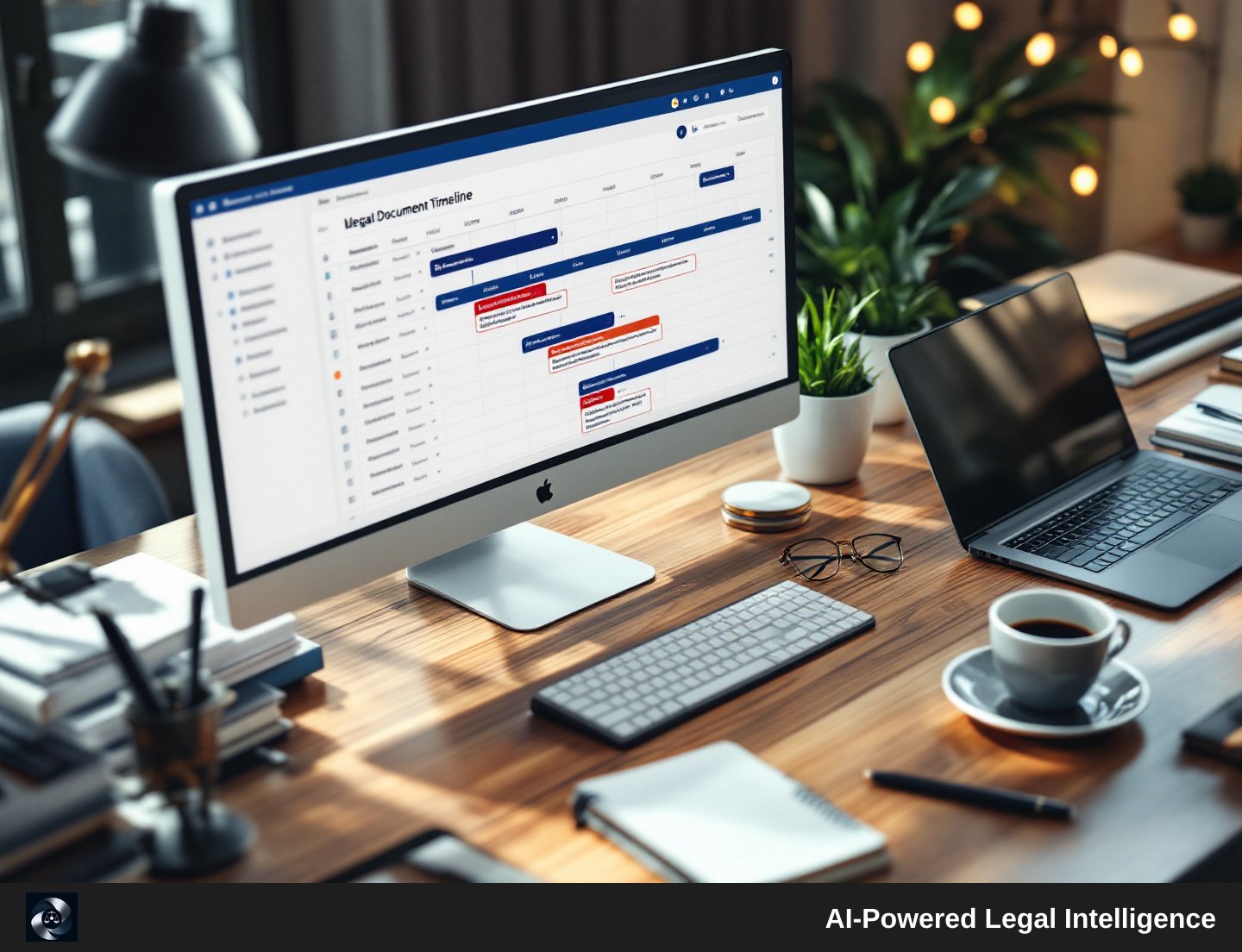
Timeline generation. A clear chronological timeline is foundational to building a compelling liability narrative and preparing witnesses. AI tools that can pull dates, events, and document references from across a case file and assemble them into a filterable, interactive timeline give attorneys a significant preparation advantage.
Cited answers to specific questions. Rather than manually searching through a file to answer a specific question — when did the plaintiff first complain of back pain? what did the treating physician say about causation? — AI chat tools can return precise answers cited to the exact page and paragraph of the source document.
None of these functions replace attorney judgment. They accelerate and sharpen the work that attorneys and paralegals do every day.
The Medical Chronology Problem — and the AI Solution
For many PI attorneys, medical record review and chronology preparation rank among the most time-consuming non-billable tasks on a case. The problem is structural: medical records are not written for lawyers. They are written for other clinicians, using abbreviations, shorthand, and documentation conventions that require translation before they can be used effectively in litigation.
The traditional workflow looks something like this: a paralegal receives a records production, organizes the documents by provider and date, reads through everything, and manually creates a chronology — typically in a Word document or spreadsheet — noting key dates, diagnoses, treatment modalities, and physician opinions. On a case with multiple treating providers, specialist referrals, imaging studies, and physical therapy records, this process can take many hours, sometimes spread across multiple days.
Automated medical record review in PI law compresses that timeline dramatically. An AI system can process the same records, identify and extract the clinically and legally relevant information, and produce a structured chronology in a fraction of the time. The attorney or paralegal then reviews the output, adds context, and finalizes it — rather than building it from scratch.
The downstream benefits are significant. Chronologies get done earlier in the case lifecycle, which means demand packages go out sooner. Attorneys go into mediation better prepared. And the risk of missing a critical notation buried on page 247 of a hospital record drops substantially.
For firms that handle high volumes of PI cases, the cumulative time savings across a full docket can be substantial — freeing staff to focus on higher-judgment work like client communication, strategy, and deposition preparation.
Building a Stronger Liability Narrative with AI-Assisted Document Review
Medical chronologies are only one piece of the PI puzzle. Establishing liability requires assembling a coherent narrative from a different set of documents: police reports, witness statements, accident reconstruction reports, surveillance footage, and sometimes employer records or OSHA documentation in workplace injury cases.
AI document analysis tools that can process all of these document types — not just text-based PDFs but also scanned images (via OCR) and audio or video files — give attorneys a unified view of their liability evidence without having to manually synthesize it across multiple systems.
To illustrate how this works in practice, consider this hypothetical example: a firm handling a multi-vehicle accident case has a file that includes the police report, statements from three witnesses taken at different times, the plaintiff's own recorded statement to the insurer, and deposition transcripts from two defendants. In this hypothetical, a paralegal using traditional methods might spend a full day cross-referencing those sources to identify where the accounts align and where they diverge.
With AI document analysis, the system can ingest all of those documents, identify the key factual claims in each, and flag contradictions automatically — noting, for instance, that Defendant A's deposition testimony about vehicle speed differs materially from what the witness statement says, or that the plaintiff's recorded statement to the insurer contains a detail inconsistent with the police report narrative.
Those flagged contradictions become the foundation for impeachment preparation, deposition strategy, and ultimately the liability narrative in the demand letter or trial presentation. The AI does not write the strategy — the attorney does. But the attorney walks into that strategy session with a complete picture rather than an incomplete one.
AI at the Deposition Table and in the Courtroom
Document analysis does not stop when the deposition starts. Some of the most powerful AI tools for PI attorneys operate in real time — during depositions and at trial.
Live deposition support tools can surface prior inconsistent statements and admissions in real time as a witness testifies, allowing the examining attorney to pivot quickly and press on contradictions while they are still fresh. This kind of real-time document intelligence is particularly valuable when deposing defense experts or hostile witnesses whose prior statements are spread across a voluminous record.
At trial, similar functionality — checking live witness testimony against prior deposition testimony and surfacing potential impeachment questions in real time — can give trial attorneys a meaningful edge, particularly in bench trials where the ability to respond precisely and quickly to unexpected testimony matters enormously.
For small PI firms that may not have a large trial team, this kind of AI-assisted real-time support can help narrow the resource gap in ways that would have been difficult to imagine just a few years ago.
Expert Services: Done-for-You AI Case Analysis
Not every firm is ready to build an internal AI workflow from scratch, and not every case is the same. For firms that want the benefits of deep AI-powered document analysis without the internal setup time, done-for-you expert services represent a practical alternative.
ProvaLens's Expert Services offering provides professional AI case analysis — delivering interactive timelines, detailed medical chronologies, and strategic observations drawn from the full case file. This is a genuine out-of-pocket case cost — similar in nature to an expert witness fee or an eDiscovery vendor cost — that a firm may pass through to the client as a case expense, at cost, with appropriate client disclosure and informed consent. It is not a markup, and it is not the same as the firm's monthly platform subscription, which is a firm overhead cost.
For high-value cases where the investment in thorough document analysis is clearly justified — catastrophic injury matters, complex liability scenarios, cases heading toward trial — this model gives firms access to sophisticated analysis without requiring internal AI expertise.
The practical effect is that even a two-attorney firm can bring the same document intelligence to a major case that a large firm might achieve with a team of paralegals and litigation support staff.
Integrating AI Document Tools into Your Existing Workflow
One of the most common concerns attorneys raise about adopting new technology is integration — specifically, whether a new tool will require rebuilding their existing workflow from scratch. For AI document analysis to deliver real value, it needs to fit into the way a firm actually operates, not demand that the firm reorganize around it.
The most useful AI document tools for PI firms connect directly to the practice management systems and document storage platforms attorneys already use. Integration with Clio and MyCase allows matters and documents to sync automatically. Connection to OneDrive, SharePoint, Google Drive, and Dropbox means documents uploaded to those platforms are automatically imported and analyzed without manual intervention. Outlook email integration means that correspondence and attachments flow into the matter record as searchable documents.
Deadline management is another practical integration point. AI tools that can extract court deadlines from scheduling orders and sync them to a case calendar — with Outlook calendar integration — reduce the administrative burden on staff and the risk of missed deadlines that can have serious professional consequences.
The goal is a workflow where the AI handles time-consuming organizational and analytical tasks — so that when an attorney or paralegal opens a matter, the most important information is already surfaced and ready to act on.
The Competitive Case for AI in a Small PI Practice
Small personal injury firms compete against larger firms with more resources and against insurance defense teams with sophisticated litigation support infrastructure. AI document analysis does not eliminate that resource gap entirely, but it narrows it in meaningful ways.
When a small firm can produce a fully cited medical chronology, a contradiction report, and a filterable case timeline in a fraction of the time it would have taken manually, the effective capacity of that firm increases — without adding headcount. Attorneys spend more time on strategy and client relationships, paralegals spend more time on high-judgment tasks, and cases move through the pipeline more efficiently.
The firms that will be best positioned as AI tools continue to mature are the ones that start building these workflows now — learning what works, refining their processes, and developing institutional knowledge about how to use AI effectively in litigation. The learning curve is real, but it is manageable, and firms that invest early in understanding these tools are likely to build durable operational advantages over time.
For PI attorneys ready to see what AI document analysis looks like in practice on their own cases, Start your free ProvaLens trial and experience firsthand how intelligent document tools can change the way your firm works.