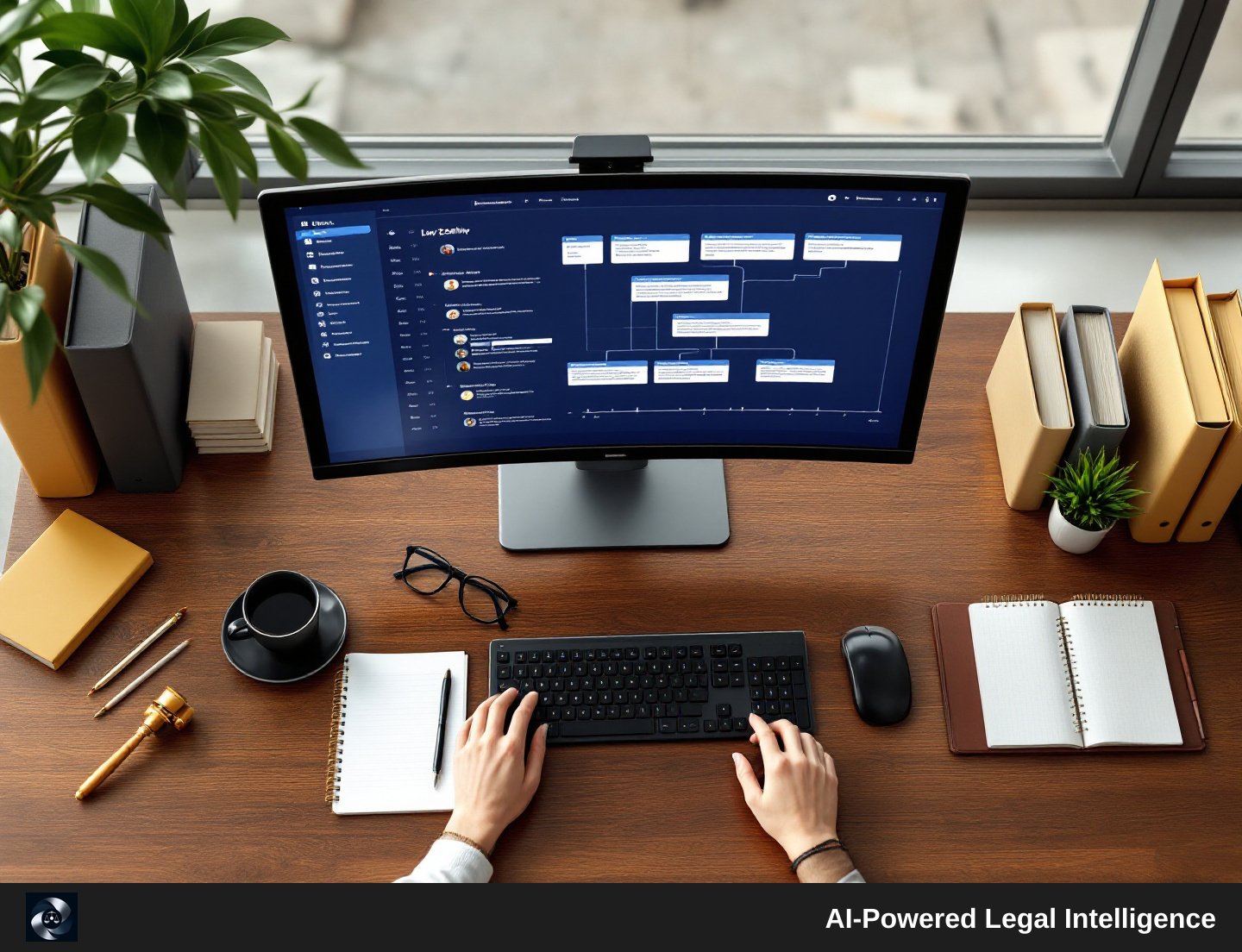
The word "eDiscovery" gets thrown around constantly in legal tech circles, but for small personal injury and employment law firms, it often lands with a thud. It sounds like something reserved for BigLaw, mass tort behemoths, or firms with dedicated litigation support departments. In reality, small firm eDiscovery is already happening — it's just often done manually, inefficiently, and at considerable cost to the firm's time and margins.
If your firm handles PI or employment cases, you are doing eDiscovery. Every time a paralegal sorts through hundreds of pages of medical records, every time an attorney searches email threads for a key admission, every time someone manually reads through deposition transcripts looking for a contradiction — that is eDiscovery review and analysis. The question is not whether your firm does it. The question is whether you are doing it in a way that is accurate, scalable, and defensible.
This post focuses specifically on the review and analysis stages of eDiscovery — what they actually involve, where small firms most commonly struggle, and how AI-powered document intelligence is reshaping what's possible without requiring a dedicated litigation support team.
What eDiscovery Review Actually Means for Small Firms
In the broader eDiscovery framework, the process spans several stages: identification, preservation, collection, processing, review, analysis, and production. Large firms and enterprise vendors often handle all of these. For small law firms in personal injury and employment law, the stages that consume the most attorney and paralegal time — and create the most risk if done poorly — are review and analysis.
Review is the process of examining collected documents to determine which are relevant, which are privileged, and which contain information that supports or undermines the case. In a personal injury matter, this means reading through medical records from multiple providers, incident reports, insurance correspondence, and witness statements. In an employment case, it means sorting through HR files, performance reviews, email chains, and payroll records.
Analysis goes a step further. It means synthesizing what you found during review into something actionable — identifying patterns, spotting contradictions, building a chronology, and connecting individual documents to specific legal theories or claim elements.
For a small firm handling these stages manually, the burden is significant. A moderately complex PI case might involve thousands of pages of records from multiple treating providers, imaging centers, and insurers. An employment discrimination matter can generate hundreds of emails and HR documents. Manual review of that volume is slow, expensive, and — critically — prone to human error.
The Processing Stage: Where Review Begins
Before any meaningful review can happen, documents have to be readable and organized. This is the processing stage, and it is where many small firms quietly lose hours they never recover.
Scanned medical records arrive as image-based PDFs. Recorded statements come in as audio files. Surveillance footage may need to be transcribed. None of these are searchable in their raw form. Processing involves converting those files into formats that can actually be reviewed — which means OCR for scanned documents, transcription for audio and video, and some form of organization so that a reviewer is not staring at a single undifferentiated folder of 2,000 files.
In a manual workflow, this processing work often falls to paralegals who spend hours on tasks that have nothing to do with legal analysis. They are relabeling files, printing and tabbing records, building spreadsheets to track what came from which provider.
AI-powered platforms handle this automatically. ProvaLens, for example, performs OCR on scanned documents and transcribes audio and video recordings, converting everything into searchable, AI-analyzable text. Documents are automatically classified by type — medical records, police reports, correspondence — and organized chronologically. That foundation makes the actual review stage dramatically faster and more reliable.
What Document Review Looks Like Inside an AI Platform
Once documents are processed and organized, review begins. In a traditional small firm ediscovery workflow, this means an attorney or paralegal reading documents sequentially, flagging important passages, and taking notes in a separate system. It is painstaking, and it scales poorly.
In an AI-assisted review workflow, the dynamic shifts. Instead of reading every page to find the relevant passages, the reviewer can ask the system a direct question and receive an answer cited to the exact page and paragraph where the supporting text appears. That is not a summary — it is a grounded, citable response that the attorney can verify in the original document.
Consider this illustrative hypothetical: a paralegal working a motor vehicle accident case needs to know whether the client's treating orthopedist ever noted a prior knee condition. In a manual review, finding that information might require reading through hundreds of pages of clinical notes. With AI-powered document intelligence, the paralegal asks the question directly and receives a response citing the specific page and paragraph — or confirms that no such notation exists across the entire record set. This scenario is hypothetical and intended to illustrate how the tool functions, not to represent an actual client outcome.
This kind of targeted, citation-grounded review changes what is possible for small firms. It does not replace attorney judgment — every finding still requires attorney verification — but it dramatically reduces the time required to surface the information that judgment needs to act on.
Gap Detection
One underappreciated aspect of small firm ediscovery review is the problem of gaps. If a client treated consistently for eight months and then there is a six-week period with no records, that gap may become a defense argument about causation or credibility. Identifying it early — before the other side does — allows the attorney to investigate and address it proactively. ProvaLens alerts users when a treating provider has no bill on file, helping surface exactly this kind of gap during review rather than at mediation.
The Analysis Stage: From Documents to Case Strategy
If review is about finding the relevant information, analysis is about understanding what it means. This is where small firm ediscovery most often breaks down — not because attorneys lack the analytical skill, but because they lack the time to synthesize large document sets into a coherent strategic picture.
Effective case analysis in a PI or employment matter typically involves several interconnected tasks:
Building a chronology. A complete timeline of events — from the incident or discriminatory act through treatment, communications, and legal proceedings — is foundational to both settlement negotiations and trial preparation. Constructing that timeline manually from dozens of documents is time-consuming. ProvaLens builds a chronological, filterable smart timeline automatically from all case documents, surfacing dates and events across the entire record set without requiring manual input.
Identifying contradictions. Perhaps the most strategically valuable output of case analysis is identifying where the documents contradict each other — or where a witness's account contradicts the medical record. ProvaLens flags these as Potential Conflicts, cited to the specific page, for attorney review. The attorney then decides whether the conflict is meaningful and how to use it. This is not autonomous legal judgment — it is a systematic flag that puts each issue in front of the attorney with its source.
Tallying special damages. In a PI case, the special damages calculation — medical bills, lost wages, future care costs — has to be accurate and defensible. ProvaLens generates an itemized special damages tally drawn from the case documents, which the attorney reviews and finalizes. This is far more reliable than a paralegal manually totaling figures from dozens of separate bills.
Flagging admissions in real time. During depositions, analysis cannot wait until the transcript arrives days later. ProvaLens offers a Live Cross Copilot that flags admissions, conflicts, and follow-up opportunities in real time as testimony is given — giving small firm attorneys deposition support capabilities that have historically required significant staffing resources.
What eDiscovery Review Does Not Cover
It is worth being precise about what the review and analysis stages of eDiscovery do — and do not — include, because the terminology is often used loosely in ways that create confusion for small firms evaluating technology.
Review and analysis do not include data collection or legal holds. Those happen earlier in the process, before documents reach the review platform. Review and analysis also do not include formal document production tasks such as Bates numbering — those are production-stage tasks that happen after review is complete. And review and analysis are not the same as legal research; they involve examining the documents in your case file, not searching case law or statutes.
ProvaLens covers the processing, review, and analysis stages specifically — OCR, transcription, AI search with page citations, and Potential Conflicts. It does not perform data collection, issue legal holds, apply Bates numbers, or handle document production. Understanding this scope helps small firms evaluate whether a tool actually addresses the stages where they are losing the most time.
Practical Considerations for Small Firm eDiscovery
For a small PI or employment firm considering how to improve its review and analysis workflow, a few practical points are worth keeping in mind.
Security is non-negotiable. Any platform that handles case documents — particularly medical records containing protected health information — must sign a Business Associate Agreement before any upload occurs and must use enterprise-grade encryption. ProvaLens signs a BAA before document upload and is hosted on Microsoft Azure with AES-256 encryption. Confirm these protections with any platform you evaluate.
Integration matters. A review platform that sits in isolation from your existing systems adds friction rather than removing it. Look for tools that integrate with your practice management software and cloud storage. ProvaLens works alongside Clio and MyCase rather than replacing them, and links OneDrive, SharePoint, Google Drive, and Dropbox folders to matters.
Expert Services as a case expense. For firms that want the benefits of AI case analysis without building an internal workflow, ProvaLens offers Expert Services — done-for-you AI case analysis, including interactive timelines, medical chronologies, and strategic observations. Because this is a genuine out-of-pocket case cost — analogous to an expert witness fee or an outside vendor — a firm may bill it to the client as a case expense at cost, with client disclosure and informed consent. Contact ProvaLens directly for current pricing. The monthly platform subscription, by contrast, is firm overhead and is not a per-client pass-through.
Attorney verification is always the last step. No AI platform — including ProvaLens — replaces attorney judgment. Every flagged conflict, every chronology entry, every damages figure requires attorney review before it is acted on. The value of AI in eDiscovery review and analysis is not that it decides anything; it is that it ensures the attorney is deciding with complete, organized, and cross-referenced information rather than whatever happened to surface during a manual read-through.
Conclusion
Small firm eDiscovery review and analysis are not abstract concepts — they are the daily work of reading records, finding contradictions, building timelines, and synthesizing case strategy. The difference between doing that work manually and doing it with purpose-built AI document intelligence is not just speed. It is the difference between a review process that might miss a critical gap or contradiction and one that systematically surfaces everything the case file contains, cited and organized for attorney action. If your firm is ready to see what that looks like in practice, Start your free ProvaLens trial.