Employment law is, at its core, a documentation discipline. Whether you're pursuing a wrongful termination claim, a hostile work environment case, or a wage-and-hour dispute, the outcome often hinges on what was written down, when it was written, and whether the paper trail tells a consistent story. For small firms handling these matters — typically two to ten attorneys juggling multiple active cases — the documentation burden is relentless.
HR files arrive in the hundreds of pages. Performance review cycles generate conflicting evaluations. Email chains between supervisors and HR span months. Deposition transcripts contradict earlier written statements. And somewhere buried in that stack of records is the inconsistency that either makes your case or unravels it.
This is the documentation challenge that defines employment law practice today. And it's exactly where artificial intelligence is beginning to make a measurable difference — not by replacing attorney judgment, but by doing the document-intensive groundwork faster and more thoroughly than any paralegal team could manage alone.
The Scale of the Employment Law Documentation Problem
Consider what a single employment discrimination case might generate: an employee personnel file, annual performance reviews spanning several years, disciplinary records, internal complaint documentation, HR investigation notes, EEOC charge responses, comparator employee files, manager communications, and recorded or transcribed witness interviews. Add depositions of the plaintiff, the decision-maker, HR representatives, and coworkers, and you're looking at a document universe that can easily exceed a thousand pages before discovery is complete.
For a small firm without a dedicated litigation support team, reviewing this volume of material thoroughly — and catching every internal contradiction — is genuinely difficult. Attorneys and paralegals doing linear document review are working against human cognitive limits. Fatigue sets in. Details get missed. The supervisor's written performance review that praises the plaintiff's work six weeks before termination gets overlooked because it was buried on page 847 of the HR production.
Opposing counsel, meanwhile, may have a larger team or better-resourced litigation support. The asymmetry is real, and it matters.
Why Contradictions Are the Currency of Employment Cases
In employment litigation, contradictions aren't just useful — they're often the case. A manager who claims in deposition that a termination was purely performance-based, but whose emails reveal a pattern of comments about an employee's age or medical leave requests, has handed you a significant piece of your case. A company that asserts it followed progressive discipline procedures, but whose own HR records show no documented warnings prior to termination, has a credibility problem.
The challenge is finding possible contradictions across a document set that no single person can hold entirely in their head. This is precisely the kind of pattern-matching work that AI handles well — and where tools built specifically for legal document analysis are beginning to deliver real value to small employment law firms.
How AI-Powered Document Analysis Changes the Workflow
AI-powered document intelligence platforms designed for legal practice don't just search for keywords. They read entire case files, understand context, and surface relationships between documents that would take a paralegal days to map manually.
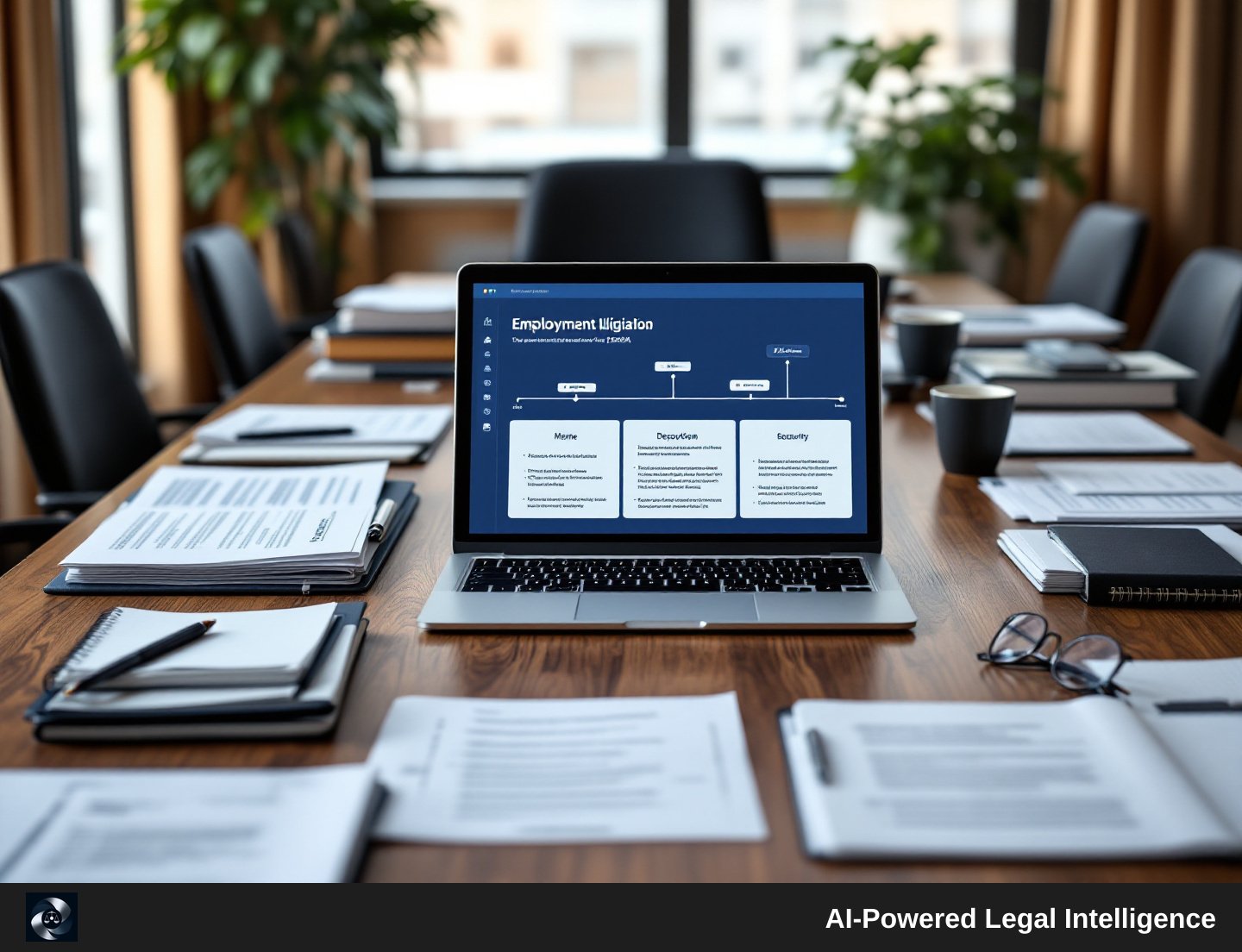
ProvaLens, for example, automatically builds chronological case timelines from all dates and events across every uploaded document. In an employment case, this means the platform can construct a unified timeline that pulls from performance reviews, disciplinary notices, internal emails, HR investigation records, and deposition transcripts simultaneously — showing the attorney exactly when events occurred relative to each other and flagging where accounts diverge.
That kind of cross-document timeline is enormously valuable in employment litigation. Did the first negative performance review appear before or after the plaintiff filed an internal harassment complaint? Was the termination decision made before or after HR received notice of the plaintiff's FMLA request? These sequencing questions are often dispositive, and answering them accurately requires holding the entire document set in view at once — something AI does naturally.
Possible-Conflict Flagging Across Hundreds of Pages
Beyond timeline construction, AI platforms built for legal work can automatically flag possible contradictions and inconsistencies across documents, for review, before opposing counsel finds them. This is particularly valuable in employment cases where the same events are described by multiple witnesses in multiple documents over an extended period.
As an illustrative example, consider a hypothetical small firm handling a retaliation claim. The plaintiff alleges she was terminated shortly after reporting safety violations. The employer's position is that the termination was part of a broader reduction in force. An AI platform analyzing the full document set might flag that the company's own internal communications show the plaintiff's position was posted for rehire within weeks of her termination — a detail that directly contradicts the RIF narrative and that might have been missed in a linear document review.
This kind of automated possible-conflict flagging doesn't replace attorney analysis. It accelerates and deepens it, ensuring that the attorney's judgment is applied to a complete picture rather than an incomplete one.
Depositions, Transcripts, and the Live Cross Copilot
Employment cases are deposition-heavy. The plaintiff, the decision-maker, HR personnel, comparator employees, and witnesses all need to be deposed, and the transcripts from those depositions need to be compared against each other and against the documentary record.
AI platforms that transcribe audio and video depositions into searchable, speaker-labeled transcripts dramatically reduce the time it takes to work with deposition testimony. Rather than reading through a 300-page transcript to find where a witness addressed a particular topic, an attorney can ask a plain-English question and receive an answer with citations to the exact page and paragraph.
ProvaLens also offers a Live Cross Copilot — a real-time tool that surfaces admissions, contradictions, and suggested follow-up questions during live depositions, whether conducted in person, via recorded session, or over Zoom, Teams, or Meet. In an employment deposition, where a manager may contradict their own prior written statements without realizing it, having that contradiction surfaced in real time gives the deposing attorney the opportunity to press the point immediately rather than catching it in transcript review weeks later.
Document Organization and Deadline Management
Beyond analysis, the administrative burden of employment cases is substantial. Document sets need to be organized by type. Court deadlines — discovery cutoffs, dispositive motion deadlines, trial dates — need to be tracked across multiple matters. Scheduling orders need to be monitored.
AI platforms that automatically classify uploaded documents by type (HR files, medical records if relevant, correspondence, deposition transcripts) and extract court deadlines from scheduling orders reduce the administrative overhead that consumes paralegal and attorney time. ProvaLens syncs with practice management tools like Clio and MyCase, imports documents from OneDrive, SharePoint, Google Drive, and Dropbox, and pulls emails and attachments directly from Outlook — creating a single, searchable case file that the entire team can access.
For a small employment law firm managing a docket of active matters, this kind of integrated organization isn't a luxury. It's a practical necessity.
Expert Services: Done-for-You AI Case Analysis
Not every firm has the internal bandwidth to build out a full AI-assisted document review workflow, even with a powerful platform available. For firms that want the analytical output without the internal process change, done-for-you expert services offer an alternative.
ProvaLens's Expert Services provide a complete AI-powered case analysis — including interactive timelines, medical chronologies where relevant, and strategic observations — starting at $3,500 per case. This is a genuine out-of-pocket case cost, similar in nature to an expert witness fee or an eDiscovery vendor charge. Firms that choose to pass this cost to the client as a case expense may do so at cost, with appropriate client disclosure and informed consent — the same approach used for other third-party case costs. The monthly platform subscription, by contrast, is firm overhead and is not a per-client charge.
For high-value employment cases where the document set is large and the stakes are significant, a done-for-you analysis can surface the kind of cross-document insights that take a paralegal team days to develop — delivered in a structured, attorney-ready format.
What This Means for Small Firm Competitiveness
The competitive reality for small employment law firms is that document-intensive cases have historically favored larger firms with more resources. AI-powered document intelligence changes that calculus. A two-attorney employment firm using a platform like ProvaLens can analyze a complex document set, build a comprehensive case timeline, flag possible conflicts across hundreds of pages, and prepare for depositions with the same depth of preparation that a larger firm's litigation support team would provide.
This isn't about replacing attorney judgment or legal expertise. It's about making sure that expertise is applied to complete, well-organized information — rather than to whatever the attorney managed to read before running out of time.
Getting Started with AI in Your Employment Law Practice
Adopting AI-powered document analysis doesn't require a technology overhaul. Platforms designed for small firms integrate with the tools already in use — case management systems, cloud storage, email — and are built to be accessible to attorneys and paralegals without a technical background.
The practical starting point is identifying the documentation bottlenecks in your current workflow. Where is time being lost? Where are details being missed? Where is the risk of overlooking a key contradiction highest? For most employment law firms, the answer points directly to the document review and deposition preparation phases — exactly where AI delivers the most immediate value.
Employment law will always be a discipline built on documentation. The question is whether your firm is reviewing that documentation with the depth and consistency the cases require — or whether important details are slipping through because the volume is simply too large for manual review alone. If you're ready to find out what a more thorough document review process looks like in practice, Start your free ProvaLens trial and see how AI-powered document intelligence can work for your firm.