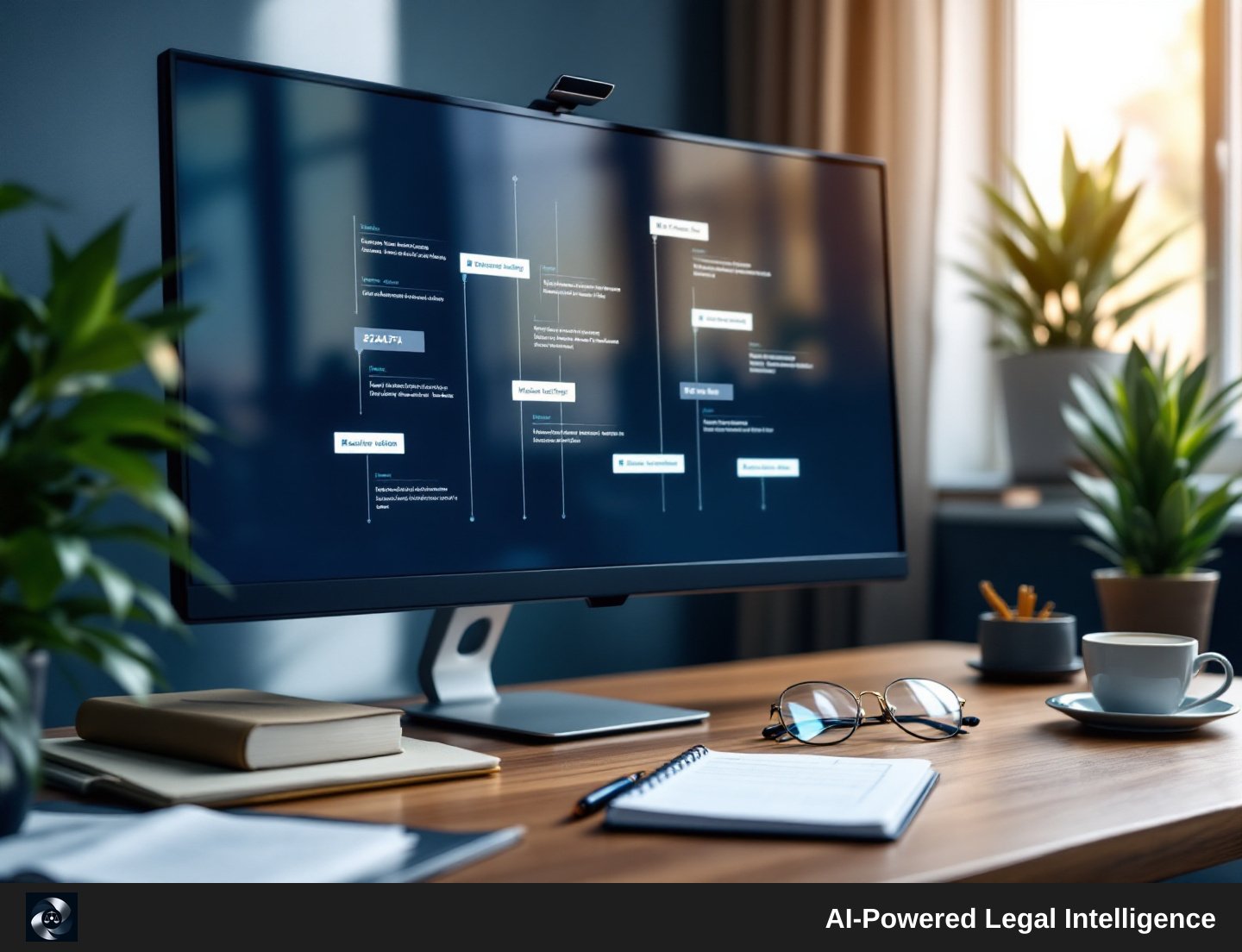
Every personal injury and employment case lives or dies on its chronology. Dates, sequences, and the spaces between them tell the story that jurors, mediators, and adjusters ultimately believe — or don't. Yet for most small firms, building a complete, accurate timeline means hours of manual review: a paralegal working through stacks of medical records, deposition transcripts, correspondence, and HR files, trying to stitch together a coherent narrative from documents that were never designed to talk to each other.
The result is almost always incomplete. Not because the paralegal wasn't thorough — but because the volume of information is genuinely beyond what any human reviewer can hold in working memory simultaneously. A treating note from month four references a symptom first mentioned in month one. A gap between provider visits looks like a gap in treatment — until you find the physical therapy records buried in a separate PDF. Defense counsel spots these inconsistencies and gaps before you do, and they use them.
AI-generated timelines change that dynamic. When an AI platform reads your entire case file and assembles every date and event into a single, filterable, citation-backed chronology, you're no longer reacting to what defense finds. You're finding it first — and either explaining it or using it yourself.
This guide walks through exactly how that works in practice, from document ingestion to strategic use at mediation and trial.
Why Manual Timelines Create Avoidable Vulnerabilities
Before exploring what AI-generated timelines can do, it's worth being honest about what manual timelines typically miss — and why those omissions matter.
The Volume Problem
A moderately complex personal injury case might involve records from a primary care physician, two or three specialists, a physical therapist, an emergency department, and a chiropractor — plus billing records, insurance correspondence, police reports, and deposition transcripts. Each of those documents is its own internal timeline. Dates appear in headers, in body text, in physician signatures, and in handwritten margin notes. No single reviewer is going to catch every one of them, especially not under the time pressure that small firms operate under.
Employment cases add another layer of complexity. HR files, performance reviews, email chains, and payroll records all contain dates that may be critical to establishing a retaliation or discrimination timeline — but they're scattered across formats and systems that were never designed for legal analysis.
The Interpretation Problem
Even when a reviewer catches a date, they have to interpret it correctly in context. A gap in treatment is meaningless unless you know whether the client had insurance coverage during that period, whether a provider was on vacation, or whether the gap was physician-recommended. Without the full picture in front of you simultaneously, those contextual connections are easy to miss.
Defense counsel, working with their own team and often more resources, is specifically looking for these gaps. A missing bill, an unexplained lapse in care, a date that contradicts a client's deposition testimony — these are the tools that complicate settlement negotiations and strengthen defense positions.
The Consistency Problem
Manual timelines are also inherently inconsistent. Different paralegals build them differently. Some are more thorough than others. The timeline built for a demand package may not reflect documents received after it was drafted. When new records come in mid-litigation, updating a manual timeline requires starting significant portions of the work over.
What AI-Generated Timelines Actually Do
AI-powered document intelligence platforms like ProvaLens approach timeline generation differently from a human reviewer. Instead of reading documents sequentially and taking notes, the platform processes your entire case file — PDFs, Word documents, scanned images, audio and video transcripts, emails — and extracts every date and event simultaneously, then organizes them into a single, filterable chronological view.
Ingestion Across Every Document Type
ProvaLens reads the full case file regardless of format. Medical records in PDF, deposition transcripts in Word, recorded statements as audio files, HR correspondence from Outlook — all of it is processed, OCR'd if necessary, and made searchable. Documents imported through integrations with Clio, MyCase, Google Drive, OneDrive, SharePoint, or Dropbox are automatically classified by type (medical records, billing, police reports, correspondence, and so on) before timeline extraction even begins.
This means the timeline isn't built from whatever the paralegal happened to review first. It's built from everything.
Citation-Backed Events
Every event that appears on the AI-generated timeline is linked back to the exact document, page, and paragraph where it was found. This is the feature that separates genuinely useful AI timelines from superficially impressive ones. When an adjuster questions a treatment date, you don't have to dig through the file to confirm it — you pull the citation directly from the timeline. When opposing counsel challenges the sequence of events at deposition, your attorney has the source document in hand before the question is finished.
This is what citation-backed medical record answers look like in practice: not a summary that might be right, but a direct link to the underlying record that proves it is.
Filterable and Visual
ProvaLens timelines are visual and filterable, meaning you can narrow the view to a specific provider, a specific type of event, or a specific date range. Preparing for a deposition of the treating orthopedist? Filter to that provider's records and see every date, every visit, every notation — in sequence, with citations. Preparing a demand package? Filter to treatment events and billing records to build your medical chronology. The same underlying timeline serves multiple purposes without being rebuilt each time.
How AI Surfaces Gaps Before Defense Does
One of the most strategically valuable things an AI-generated timeline does is reveal what's missing. When every document in the file is represented, gaps become visible in a way they simply aren't when you're reviewing records one at a time.
Spotting Treatment Gaps Proactively
The following is a purely fictional illustration and does not describe any real client or matter. Imagine a hypothetical personal injury matter involving a soft-tissue neck injury. The client treated consistently for three months, then there is a six-week gap before treatment resumed. On a manual timeline, that gap might be noted — or it might not be, depending on how carefully the reviewer was working. On an AI-generated timeline, that gap is structurally visible: the events stop, and then they resume. The attorney sees it immediately and can investigate the cause before opposing counsel raises it. In this fictional scenario, the explanation might be simple: the client lost insurance coverage during that period and couldn't afford out-of-pocket visits. That's a legitimate explanation that actually humanizes the client. But without the AI timeline surfacing the gap, the attorney might not have known to ask — and defense counsel could have used it at mediation.
Missing Bills and Provider Gaps
ProvaLens includes alerts when a treating provider has records in the file but no corresponding bill. This is a specific, concrete version of gap detection: the platform identifies what providers are represented across the case file and flags when the billing record doesn't match. For a demand package, this matters — missing bills can mean undervalued specials and a weaker opening position.
Surfacing References to Prior Conditions Mentioned in Records
This is one of the questions attorneys most commonly ask when evaluating AI document tools: can the platform surface references to prior injuries or pre-existing conditions that are scattered across a large file? The answer is yes — in the sense that ProvaLens processes the entire file and can surface mentions, references, and notations that a human reviewer focused on accident-related records might not flag. When a client's medical history spans years and multiple providers, a passing mention in a primary care note from two years earlier may appear in the AI-generated timeline alongside everything else.
This matters in two directions. Defense counsel is looking for exactly these references to argue that the client's injuries predate the accident. If you find them first, you can address them proactively in the demand narrative, distinguish the prior condition from the acute injury, and prepare your client accordingly. The platform surfaces what's in the documents; the attorney's judgment determines how to use it.
Using the Timeline Strategically at Every Stage of the Case
An AI-generated timeline isn't just a case-organization tool. Used correctly, it's a strategic asset that serves different purposes at different stages of litigation.
Demand Package Preparation
The timeline forms the backbone of a well-constructed demand package. A complete, chronologically organized treatment narrative — with every provider visit, every diagnosis, every gap explained — tells the story of your client's injury in a way that's hard to argue with. ProvaLens generates itemized medical chronologies and special-damages tallies that can be exported to Word for attorney review and incorporated directly into demand letters. The citation-backed format means every figure in the demand is traceable to the underlying record.
Deposition Preparation
Before deposing a treating physician, a defense expert, or an adverse witness in an employment matter, the AI timeline lets you see every event associated with that witness — every note, every record, every date — in sequence and with citations. You can identify where their testimony is likely to conflict with the documentary record and prepare impeachment questions grounded in specific documents. This is deposition preparation at a level of thoroughness that manual review simply can't match under real-world time constraints.
Live Deposition Support
ProvaLens also offers a Live Cross Copilot feature that operates during depositions — in person, via Zoom, Teams, or Google Meet — flagging admissions and conflicts in real time, cited to the timestamp. This means that when a witness says something that contradicts a document in the case file, the attorney gets an alert during the deposition, not three days later when reviewing the transcript. The platform also transcribes audio and video depositions into searchable, speaker-labeled transcripts for later review.
Mediation and Trial
At mediation, a visual, filterable timeline is a persuasion tool. Adjusters and mediators respond to organized, well-documented chronologies. When every event is sourced and citable, the narrative is harder to dispute. At trial, the same timeline supports demonstrative exhibits and helps attorneys respond immediately when defense counsel mischaracterizes the sequence of events.
Integrating AI Timelines Into Your Firm's Workflow
The practical question for any small firm is how AI timeline generation fits into existing workflows without creating new overhead.
Setup and Document Import
ProvaLens integrates directly with Clio, MyCase, Google Drive, OneDrive, SharePoint, and Dropbox, meaning documents already stored in those systems can be imported automatically into matters. Outlook emails and attachments can be pulled in directly as case evidence. OCR handles scanned documents. Audio and video depositions are transcribed into searchable, speaker-labeled transcripts. In most cases, getting the documents into the platform is not a separate step — it's a continuation of what the firm is already doing.
Who Does the Work
For firms that want to generate timelines in-house, ProvaLens's platform tools — AI chat with citations, automatic timeline generation, document classification, and missing-bill alerts — are available on a flat-rate subscription priced by active matters, not per seat. Paralegals and attorneys can both use the platform, and archived cases remain searchable at no additional cost. This subscription is a firm overhead cost.
For firms that want a fully assembled work product without the in-house effort, ProvaLens's Expert Services offer done-for-you AI case analysis — delivering interactive timelines, medical chronologies, and strategic observations prepared by the ProvaLens team. Pricing for Expert Services is available directly from ProvaLens. Unlike the platform subscription, this per-case Expert Services fee is a genuine out-of-pocket case cost that a firm may bill to the client as a case expense — similar to an expert fee or eDiscovery cost — at cost, with appropriate client disclosure and informed consent.
Deadlines and Calendar Integration
ProvaLens also extracts deadlines from court scheduling orders and syncs them to a matter calendar with optional Outlook integration. This means the same platform that generates your case timeline is also tracking your litigation deadlines — reducing the risk that a missed date compounds the problems that a disorganized case file creates.
Conclusion
The gap between what's in a case file and what an attorney actually knows about that case is where defense counsel operates. AI-generated timelines help close that gap by processing every document simultaneously, surfacing every event with a citation, and making gaps and inconsistencies visible earlier in the process. For personal injury and employment attorneys at small firms, the practical question is whether building timelines manually — with the inherent risk of missed dates, undetected gaps, and inconsistent coverage — is the best use of your team's time when tools exist to do it more completely. If you're ready to see what a complete, citation-backed case chronology looks like before you commit to the process, Start your free ProvaLens trial.