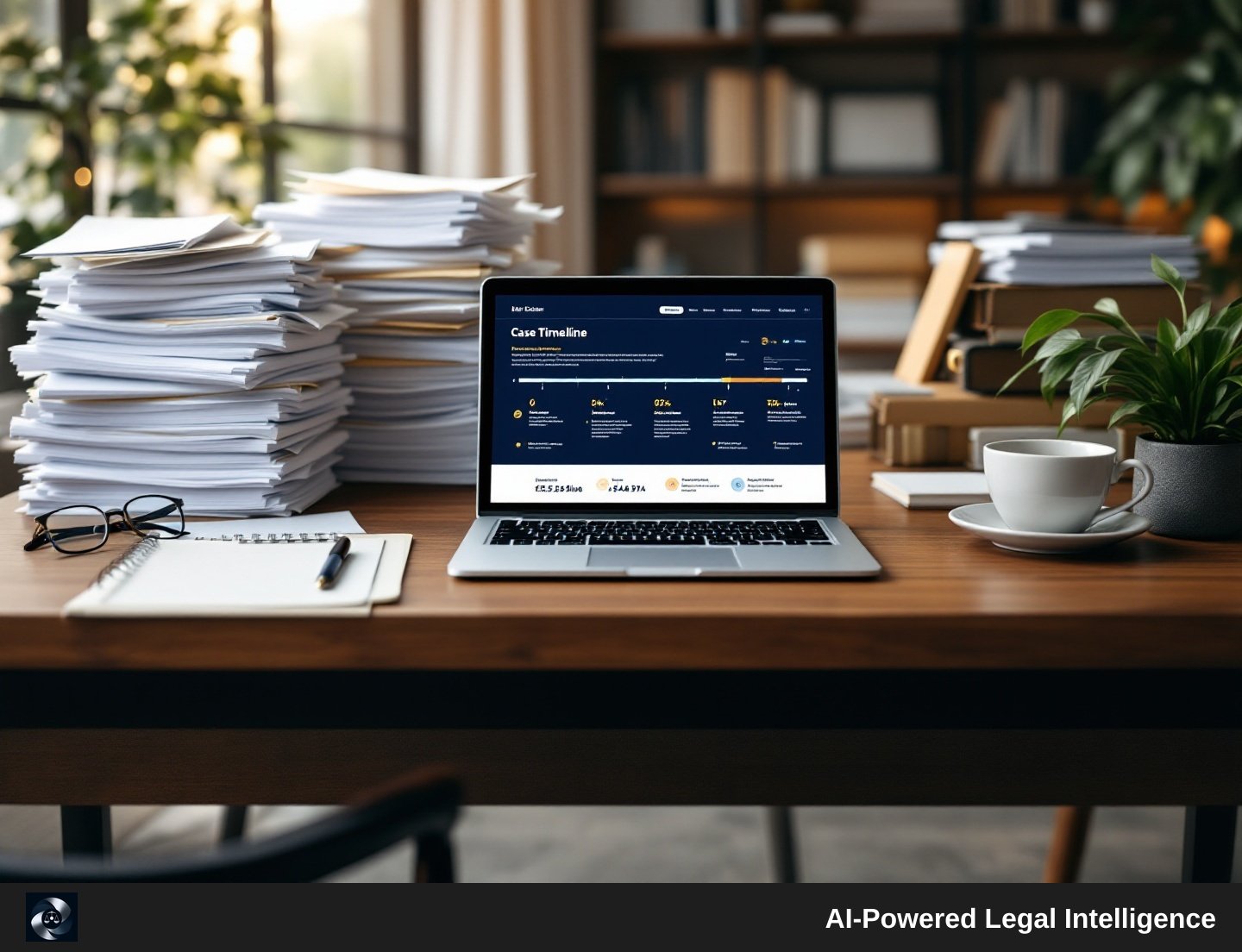
Personal injury cases are won or lost on the strength of medical evidence. A thorough review of treatment records, imaging reports, billing statements, and physician notes can mean the difference between a compelling demand letter and a weakened claim. Yet for small PI firms — those running lean with two to ten attorneys — the manual process of combing through hundreds or thousands of pages of medical records remains one of the most time-consuming, error-prone tasks in the entire case lifecycle.
Automated medical record review is changing that equation. By applying AI-powered document intelligence to the full case file, PI attorneys can surface key facts faster, catch inconsistencies that might otherwise slip through, and spend their limited hours on the legal strategy that actually requires a lawyer's judgment. This post explores what that shift looks like in practice, why it matters for case preparation, and how to evaluate the tools and services available.
Why Manual Medical Record Review Is a Hidden Bottleneck
Ask any PI paralegal how much time they spend on medical records and the answer is almost always the same: more than it should be. A moderately complex auto accident case might generate records from an emergency room, a primary care physician, two or three specialists, a physical therapist, and a chiropractor. Each provider uses different formatting, different terminology, and different organizational conventions. Billing records arrive separately from clinical notes. Imaging reports reference studies that may or may not be included in the file.
The paralegal or associate attorney assigned to review these records must read every page, manually extract treatment dates and diagnoses, flag gaps in care, and reconcile the timeline across providers — all before a demand letter can be drafted. In a firm handling dozens of active cases, this process creates a perpetual backlog.
The risk is not just inefficiency. It is also accuracy. When a reviewer is fatigued or working under deadline pressure, it is easy to miss a critical notation buried on page 312 of a 400-page record set. That missed notation could be a pre-existing condition the defense will exploit, an inconsistency in the client's reported symptom onset, or a gap in treatment the adjuster will use to argue the injury was not serious. Manual review leaves these landmines undetected.
What Automated Medical Record Review Actually Does
The term "automated medical record review" covers a spectrum of capabilities. At the most basic level, it means using AI to read and organize documents so attorneys and paralegals can find information faster. At a more sophisticated level, it means the system actively analyzes the records, extracts structured data, and flags issues the human reviewer might not have thought to look for.
For PI attorneys, the most valuable capabilities include:
Medical Chronology Generation
A well-constructed medical chronology is the backbone of a PI demand package. It documents every treatment event in date order, links each event to the injury at issue, and demonstrates the arc of the client's recovery — or the permanence of their impairment. Building this manually is a multi-hour task even for an experienced paralegal.
AI-powered platforms can extract treatment dates, provider names, diagnoses, and procedure codes from across the entire record set and assemble them into a structured chronology automatically. The output is not a guess or a summary — it is a cited, document-referenced timeline that the attorney can review and finalize rather than build from scratch.
Contradiction and Inconsistency Detection
One of the most powerful applications of automated medical record review in PI law is inconsistency detection. Medical records contain contradictions more often than attorneys realize: a treating physician's note that conflicts with an IME report, a client's reported symptom onset in a deposition that does not match the first emergency room visit, or a gap in treatment that the records themselves explain differently in different places.
AI systems that read the entire case file simultaneously — not page by page in isolation — can surface these contradictions automatically. This serves two purposes. First, it helps the plaintiff's attorney anticipate and address weaknesses before the defense does. Second, it helps identify where the defense's own expert or IME physician may be contradicting the contemporaneous treating records — a powerful impeachment tool.
Special Damages Tally
Medical billing records are notoriously difficult to reconcile. Charges appear in multiple formats, some records include adjustments and write-offs, and the relationship between billed charges and paid amounts matters enormously in jurisdictions that apply collateral source rules. Automated platforms can extract line-item charges across all billing records and generate an itemized special damages tally, giving the attorney a defensible number to anchor the demand.
The Case for AI Chat with Source Citations
Beyond structured outputs like chronologies and damage tallies, one of the most practical tools for PI attorneys is AI chat that answers questions about the case file with citations to exact source documents.
To illustrate how this might work in practice, consider a purely hypothetical scenario: a paralegal is preparing for a deposition of the defense's IME physician. She needs to know every instance in the treating records where the client reported the specific symptom the IME doctor says is inconsistent with the mechanism of injury. In a manual workflow, she would re-read hundreds of pages of notes looking for those references. With AI chat, she asks the question in plain language and receives a cited list of every responsive passage — page number, paragraph, document name — in seconds. (This scenario is illustrative only and does not represent an actual client matter.)
This hypothetical illustrates a genuine capability difference. The critical requirement is that every AI answer must be cited to the source document. Uncited AI outputs in a legal context are not just unhelpful — they are dangerous. Any platform used for automated medical record review in PI law should return answers that are traceable to the exact page and paragraph in the original record.
Expert Services vs. Self-Service: Understanding Your Options
When evaluating tools for medical record review automation, PI firms typically encounter two models: self-service AI platforms and done-for-you expert services. Understanding the difference matters when budgeting for these capabilities.
A self-service platform gives the firm's own staff access to AI tools — document upload, timeline generation, possible-conflict flagging, AI chat — on a subscription basis. The firm does the work, but the work is dramatically faster and more thorough than manual review. Flat-rate, per-firm pricing (not per-seat) makes this model cost-effective even for small firms with lean teams.
A done-for-you expert service takes a different approach: the provider's analysts use AI tools to deliver a finished work product — an interactive timeline, a complete medical chronology, a strategic observations memo — back to the firm. The firm receives the output without having to invest staff time in the process itself.
The billing treatment of these two models is different, and it matters. A monthly platform subscription is a firm overhead cost, similar to case management software — it is not a per-client pass-through. A per-case expert service is a genuine out-of-pocket case expense. Whether and how that cost may be passed through to a client depends on applicable bar rules in your jurisdiction, proper disclosure to the client, and the client's informed consent. Firms should consult their own ethics counsel about how these costs are treated in their jurisdiction.
When comparing self-service subscriptions against per-case AI analysis services, the relevant question is not just the dollar amount — it is whether the cost is case-specific or firm-wide, and whether the output is a deliverable the client's file actually requires.
Practical Tips for Implementing Medical Record Review Automation
For PI firms considering a transition to automated medical record review, a few practical principles will smooth the process:
Start with your most document-heavy cases. The ROI of automation is most visible on cases with large record sets — catastrophic injury cases, long-term disability claims, cases with multiple treating providers over years of care. These are also the cases where manual review is most likely to miss something important.
Review and finalize every AI output before it leaves the firm. Automated chronologies and damage tallies are tools for the attorney to review and finalize — not documents to send to the adjuster without review. ProvaLens generates cited, document-referenced outputs precisely so the attorney can efficiently verify each item against the source record before signing off.
Verify citations before relying on them. Any platform worth using will cite every output to the source document. Make it a workflow standard to spot-check those citations — not because the AI is likely to be wrong, but because the attorney signing the demand letter is professionally responsible for its accuracy.
Use possible-conflict flagging proactively. Do not wait for the defense to find inconsistencies in your client's records. Run the analysis early, understand what the defense will see, and address it in your demand narrative or prepare your client accordingly.
Integrate with your existing systems. Platforms that sync with case management tools like Clio or MyCase, and with cloud storage like Google Drive or OneDrive, reduce the friction of adoption. The goal is to make AI analysis a seamless part of the existing workflow, not a separate silo.
The Competitive Advantage of Moving First
The PI attorneys who will benefit most from medical record review automation are not necessarily the ones at the largest firms. They are the ones who move first within their market segment. A small firm that can produce a meticulously documented medical chronology, a fully cited demand package, and a deposition preparation memo in a fraction of the time it takes a competitor is not just more efficient — it is more responsive to clients and better positioned to handle more complex, document-intensive matters as their practice grows.
Automated medical record review in PI law is not a future trend. It is a present capability that is already reshaping how competitive small PI firms operate. The question is not whether to adopt it, but how quickly and how well. If you are ready to see what AI-powered document intelligence looks like in practice for your firm, Start your free ProvaLens trial.