Every personal injury attorney knows the feeling: you've reviewed hundreds of pages of medical records, you believe you have a complete picture of your client's injuries, and then — during mediation or at deposition — opposing counsel surfaces a detail you missed. A gap in treatment. A provider note that contradicts your client's stated onset date. A bill for a procedure that never appears in the clinical notes.
Manual medical record review is not simply slow. It is structurally prone to certain categories of error that no amount of diligence fully eliminates. The human brain is not optimized to cross-reference 600 pages of records from seven providers while simultaneously tracking billing codes, treatment dates, and provider statements for internal consistency. AI medical record analysis for personal injury attorneys is built to do exactly that — and it surfaces the specific categories of issues that manual review most reliably misses.
This post walks through what those categories are, why they slip through traditional review, and how automated medical record review in PI law changes the equation.
Why Manual Review Has Structural Blind Spots
Before examining what AI finds, it is worth understanding why manual review misses things in the first place. The problem is rarely attorney or paralegal competence. It is the nature of the task itself.
Medical records in personal injury cases arrive from multiple providers — emergency rooms, primary care physicians, orthopedists, pain management specialists, physical therapists, imaging centers, and pharmacies. Each provider uses different formatting, different terminology, and different organizational logic. Records arrive in different orders, sometimes duplicated, sometimes incomplete. Billing records and clinical records are often produced separately, making cross-referencing labor-intensive.
When a paralegal reviews these records linearly — reading through them sequentially — they build a mental model of the case. But that mental model is vulnerable to anchoring bias: once an early impression forms, later contradictory details are easier to overlook. And when the record set exceeds a few hundred pages, the cognitive load of tracking every provider statement, every date, and every diagnosis code simultaneously becomes genuinely unmanageable.
AI medical record review for injury claims does not read linearly. It processes the entire record set simultaneously, cross-references every date and statement against every other date and statement, and flags anomalies without fatigue or anchoring bias.
The Four Categories AI Catches Most Reliably
1. Treatment Gaps That Undermine Causation Narratives
One of the most common issues defense counsel exploits is a significant gap in treatment — a period of weeks or months where the client sought no medical care. Gaps can be entirely legitimate (financial hardship, loss of insurance, personal circumstances), but they require proactive explanation. If you do not identify and address them before the demand package goes out, opposing counsel will.
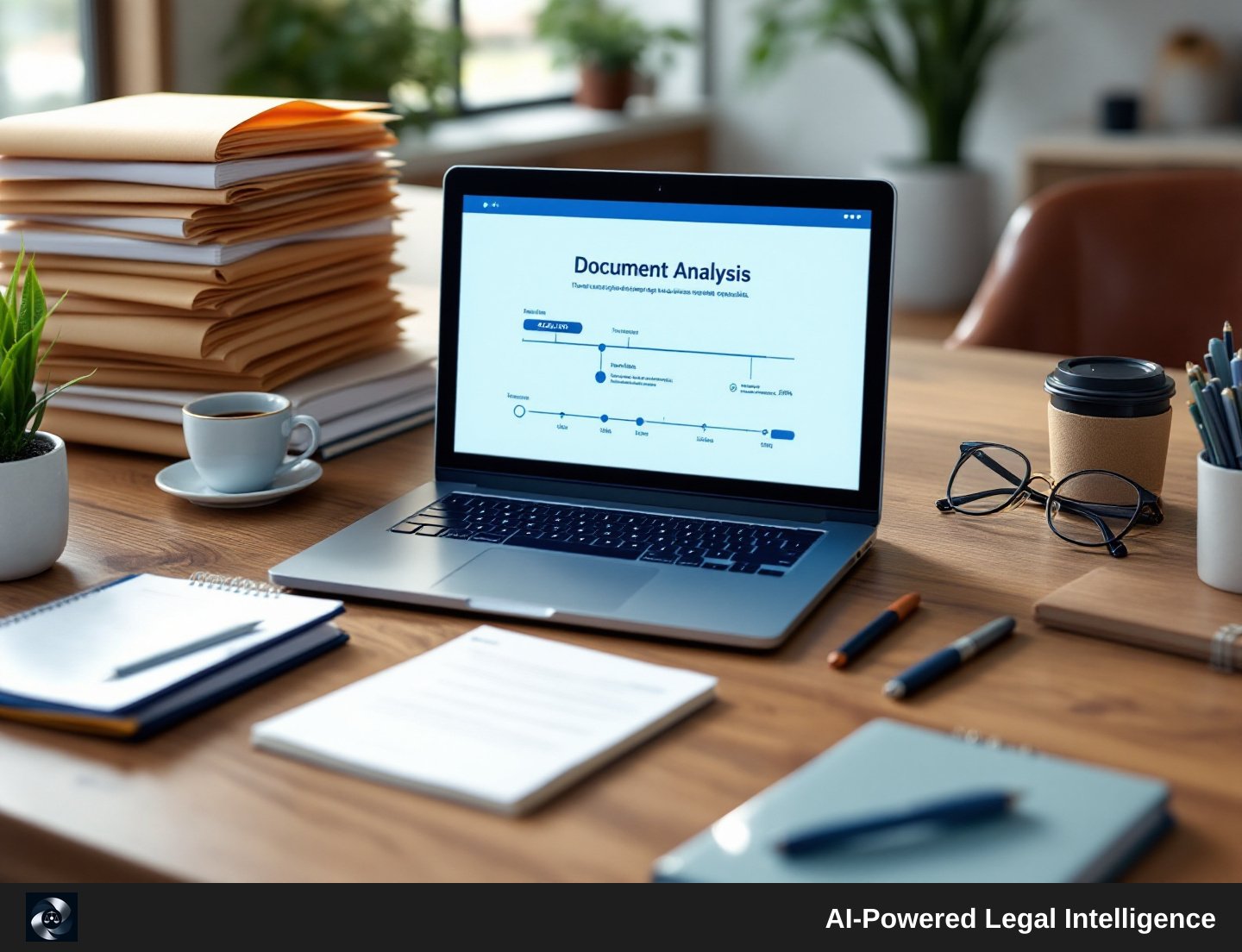
Manual review catches obvious gaps when a paralegal happens to notice the jump in dates. But when records arrive from multiple providers, gaps are easy to miss because treatment at one provider may partially mask a gap at another. AI medical record analysis for personal injury attorneys builds a unified chronological timeline across all providers simultaneously, making every gap visible regardless of which provider's records it falls between.
ProvaLens, for example, automatically generates a filterable case timeline from all uploaded documents, allowing attorneys to see the full treatment arc at a glance — and to spot any period where no provider was seen.
2. Billing Records That Don't Match Clinical Notes
A bill for a procedure or service that does not appear in the corresponding clinical notes is a significant problem. It can be a documentation error, a coding issue, or something more serious — but in any case, it is the kind of discrepancy that opposing counsel will use to challenge the legitimacy of your damages claim.
Manual review rarely catches these mismatches because billing records and clinical records are typically reviewed separately. The paralegal reviewing clinical notes is not simultaneously cross-referencing every line of the billing ledger, and vice versa.
Automated medical record review in PI law addresses this by processing billing records and clinical records together, flagging instances where a billed service has no corresponding clinical documentation. ProvaLens also alerts users when a treating provider has no bill on file at all — a gap that can quietly undercut a damages calculation if it goes unnoticed until late in the case.
3. Provider Statements That Contradict Each Other
Consider this illustrative hypothetical example: a client's emergency room records describe the mechanism of injury one way, the primary care physician's intake notes describe it differently three days later, and the orthopedist's initial evaluation references a prior injury to the same body part that the client never disclosed. Each document, read in isolation, seems unremarkable. Read together, they present a contradiction that defense counsel will exploit at deposition.
This category of issue — cross-document contradiction — is the hardest for manual review to catch, because it requires holding the content of multiple documents in working memory simultaneously while reading a third. AI contradiction detection is purpose-built for exactly this task. ProvaLens flags potential conflicts across documents, cited to the exact page and paragraph, so attorneys can evaluate each one and decide how to address it before it surfaces at the wrong moment.
4. Pre-Existing Condition References Hidden in Clinical Language
Clinical notes frequently reference prior conditions, prior treatments, or prior imaging findings using language that is easy to overlook if you are not specifically searching for it. A note that mentions "chronic changes" on an MRI, or a physical therapy intake that references a prior course of treatment for the same region, can significantly affect causation arguments — and they appear in the middle of dense clinical prose that is easy to skim past.
AI medical record analysis for personal injury attorneys reads every line of every document without skimming, and can surface references to prior conditions, prior providers, or prior treatment across the entire record set. This allows the attorney to assess the pre-existing condition issue proactively rather than reactively.
How AI Medical Chronology Changes Case Preparation
Beyond catching specific categories of issues, AI medical chronology for personal injury cases changes the overall structure of case preparation in a meaningful way.
Traditionally, building a medical chronology is one of the most time-intensive tasks in PI case prep. A paralegal reads through the records, extracts relevant entries, organizes them by date, and produces a document that becomes the backbone of the demand letter. On a complex case with multiple providers and several hundred pages of records, this can take days.
AI medical chronology tools generate that chronological structure automatically from the uploaded documents. ProvaLens classifies, dates, and organizes documents by type — medical records, billing, imaging, pharmacy — and builds a timeline that attorneys can filter and navigate. The resulting chronology is not a replacement for attorney judgment; it is the foundation that attorney judgment is applied to, produced in a fraction of the time.
This matters for small firms in particular. When a two- or three-attorney practice is managing a high volume of cases simultaneously, the paralegal hours saved on chronology production can be redirected to higher-value work — or used to take on additional cases without adding headcount.
What to Do With What AI Finds
Identifying issues is only half the work. The value of AI medical record analysis for personal injury attorneys is realized when the attorney uses the flagged issues strategically.
For treatment gaps: develop the explanation proactively and address it directly in the demand letter. A gap explained is far less damaging than a gap discovered by opposing counsel.
For billing mismatches: follow up with the provider before the demand goes out. Determine whether the issue is a documentation error that can be corrected or a billing anomaly that needs to be addressed differently.
For provider contradictions: assess whether the contradiction is material to causation or damages. If it is, prepare to address it at deposition. If it reflects a documentation inconsistency that can be explained, address it in the narrative.
For pre-existing condition references: build your causation argument around the aggravation framework before defense counsel frames it as a bar to recovery.
In each case, the AI surfaces the issue early enough that the attorney can make a deliberate strategic choice rather than reacting under pressure.
When to Consider Expert-Level AI Case Analysis
For straightforward cases, the self-service platform capabilities described above are often sufficient. But for high-value cases, complex multi-provider record sets, or cases heading toward trial, some firms benefit from a more comprehensive analysis.
ProvaLens offers Expert Services — done-for-you AI case analysis performed by the ProvaLens team — that delivers interactive timelines, detailed medical chronologies, and strategic observations. Pricing for Expert Services is not a platform subscription; it is a genuine out-of-pocket case cost, similar in nature to an expert witness fee or an eDiscovery expense. Contact ProvaLens directly for current Expert Services pricing. Firms that choose to pass this cost to the client as a case expense may do so at cost, with appropriate client disclosure and informed consent — the same approach used for any other third-party case cost.
This option is particularly relevant for cases where the record volume is large, the damages are significant, or the attorney wants a second set of analytical eyes before a high-stakes mediation or trial.
Getting the Most Out of AI Medical Record Review
A few practical notes for attorneys integrating AI medical record analysis into their workflow:
Upload early. The earlier in the case lifecycle you upload records, the earlier you can identify issues that affect case strategy. Waiting until demand letter preparation means you may have already made strategic commitments based on an incomplete picture.
Upload completely. AI analysis is only as good as the documents it has access to. Billing records, pharmacy records, and imaging reports are as important as clinical notes. If a provider has records on file that you have not yet obtained, the gap in your analysis will reflect that gap.
Review flagged contradictions critically. Not every flagged potential conflict is a material problem. AI contradiction detection surfaces anomalies for attorney review — the attorney's judgment determines which ones matter and how to address them.
Use the chronology as a drafting tool. The AI-generated timeline is a natural starting point for the medical narrative section of a demand letter. It is not a finished product, but it is a structured, citable foundation.
Small personal injury firms that integrate AI medical record analysis into their standard workflow gain something meaningful: the confidence that comes from knowing the record set has been reviewed comprehensively, not just thoroughly. That confidence supports more deliberate case preparation and more fully informed demand framing. If you are ready to see what a complete AI-powered review of your case records looks like in practice, Start your free ProvaLens trial and upload your next case file.